

An interview with Alex Rosenberg
Author of "Death of a Panda Ventriloquist"
Hello, Callers! Thank you for being here.
Venture capitalists are a cutthroat lot, so perhaps it’s no surprise they make great fodder for crime fiction. Alex Rosenberg, author of last week’s feature story “Death of a Panda Ventriloquist,” joins us today to talk about his writing process, his favorite writers working today, and just how much of his story of a fictional startup was based on real-life experience.
This story feels very much “from the trenches” of the start-up world. Was it inspired by a particular job or experience? How did it evolve from the initial concept to the final version as published?
Ha, yes. I did hold a job that was really very similar to the protagonist’s, only the videos that we made weren’t about animals. And there was, you know, less fraud and murder.
In the first draft of the story, there was a whole preamble about how interest rates have risen and so startups that raised money at high valuations have run into trouble raising fresh rounds of capital. It was only slightly less boring than it sounds as I say it now. A rising-interest-rate environment still makes up the setting of the story, but thankfully I managed to make the invisible hand of the market much more invisible as I revised.
During your revision process, do you share drafts with other people? How do you hone your own sense of whether a piece is working or not?
Well, I always share drafts with my wife, Michelle. Her comments tend to fall into one of two categories: A) “I finished reading the story – it’s great!” B) “I finished reading the story.” What’s also helpful is just asking her what she thinks literally happened in the story. That’s the whole challenge, isn’t it, getting this thing that’s in our head into someone else’s head? It’s the first and more important purpose of a story, and if we fail at that, we fail at everything. So it’s always dispiriting – but very helpful – when she reports back an alternate series of events than the ones I’d been meaning to capture. Then I need to either edit the story to make it clearer, or – and this has happened – to make it conform more closely to what she believed I meant to say. Because hey, sometimes her version is more interesting.
What’s your own history with writing fiction? Is this a longstanding interest or something you’ve come to more recently?
Would you believe that I went to college and basically majored in writing fiction, and they never bothered to tell us that you’re supposed to have a plot? I think that might explain why so many well-written books are so aimless nowadays. Anyway, once I found out about the whole plot thing, my stuff got a lot better.
What’s your writing routine like?
You know how Elmore Leonard used to write every morning for like four hours before going to his job in Detroit? I tried to do something like that, and for a while I succeeded. But these days I mostly write on the weekends and on the train into work. Whenever I’m feeling a bit bad about that, I console myself by thinking it’s good to have a writing routine that isn’t too routine, that it’s useful to train yourself to find time to write no matter what’s going on in your life. Most of this particular story was written at a coffee shop in downtown Las Vegas between poker tournaments.
Throughout the story, it’s hard to tell sometimes whether Matej has bought into his own bullshit, which is part of what makes him such an interesting character. Do you think he knows what he’s doing? Does it matter if he does?
What a great question. To me, this is why startups are so interesting. The whole idea of a startup is that you present this grand vision of what your company will become, and immediately treat it as reality so that other people – investors, employees, clients – buy into it. “I live in in the future,” the CEO of the actual startup I used to work at would always say. The way this is supposed to work is that, along the way, you hit “milestones” and rack up “wins” that show you’re actually moving in the direction that you’ve foreseen. But what happens when you’re instead hitting trees and racking up losses? Do you change your vision of the future, or do you change your characterization of the present? That’s what this story is about.
This story is narrated in the first person, which usually reassures the reader that the narrator is going to survive. But that’s not the case here! How did you make those choices? Was there any temptation to change the narration once you realized how the story would end?
You’re right that the narrator rarely dies, though I’m not exactly sure why that is. I suppose it’s because when we’re reading a story, it’s as if someone is telling it to us. So we sort of imagine that we’ve wandered into, like, a dusty old saloon and what we’re reading is what this haggard guy at the end of the bar is telling us. But, like, he’s not? I don’t know, maybe I’m under-thinking this.
In this story, I think you need to hear the narrator’s thoughts to understand why he’s being killed. He thinks it’s absurd that Matej is killing him, since he doesn’t understand why someone would care so much about the success of a company. But it’s precisely because of that defect (well, if it is a defect) that he’s being killed. And it only occurs to him at the very end that Matej has a bit of a point.
Who are some of your favorite writers working today?
Certainly Laird Barron is one. Speaking of unusual first-person stories, his “Bulldozer” is possibly my favorite short story of all time. On maybe the other end of the spectrum, it’s hard not to mention Sally Rooney, that great master of photorealistic interiority.
Within the mystery genre, I’m a huge fan of Walter Mosley, who I think is somewhat underappreciated. To me, the grand lineage of noir goes Hammett to Chandler to MacDonald to Mosley. And he’s still turning out new books every year! Jonathan Ames is also terrific; you’d be hard-pressed to find a more entertaining mystery than A Man Named Doll.
What else are you working on? Where can people go to find more of your work?
Well, I’m putting the finishing touches on a novel that’s somewhere in the domestic thriller zone. So if you see me in a Vegas coffee shop, that’s why.
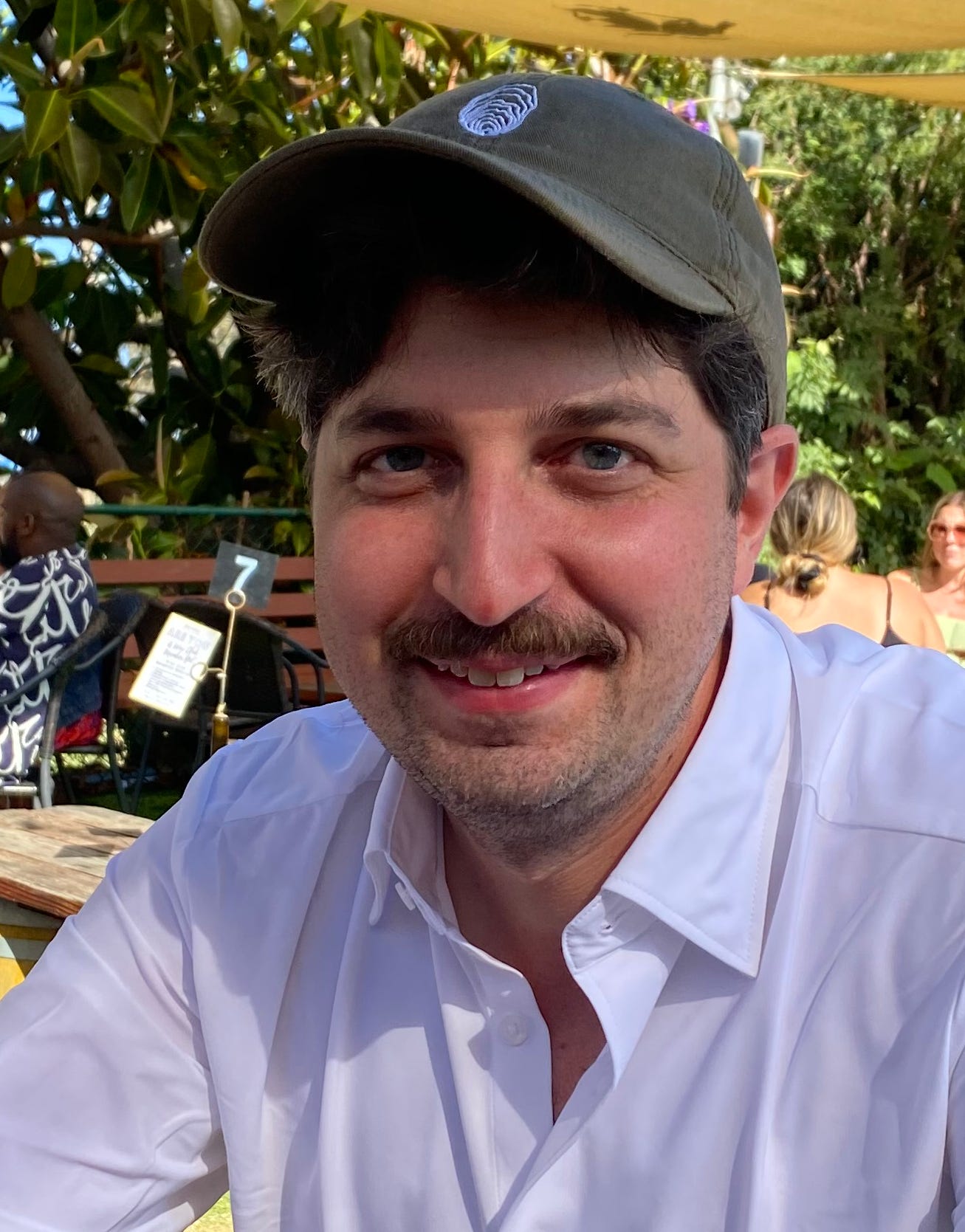
Alex Rosenberg is a mystery and horror writer. His stories have appeared in Mystery Tribune, White Wall Review, the GabaGhoul anthology and, fittingly, Schlock! By day he makes videos about money. He lives in Port Washington, New York with his wife, daughters, and cats.
Thanks for giving us a look under the hood on this story.