

An interview with David Rachels
Author of "Operation T.O.O.T.H.: An Oral History"
Hello, Callers! Thanks for being here.
In David Rachels’ “Operation T.O.O.T.H.,” police officers, reporters, criminals, and even a ‘methodontist’ offer up an oral history of a drug operation gone sideways. It’s a very funny piece—and one with some surprising craft lessons about character, escalation, and using multiple points of view to tell a great story.
COLD CALLER: When did you first start writing fiction? Was there anyone who particularly encouraged or influenced you as you were starting out?
DAVID RACHELS: I started when I was a little kid, writing these really short stories that were sort of outlines of outlines, and I just kept going from there. I got big encouragement when I was in the ninth grade from my Alabama history teacher, Shirley Sanders, who also wrote romance novels. Mrs. Sanders had a bunch of old typewriters in the back of her classroom, and she encouraged me to sit back there during my free periods and write, and then she would praise everything I did, no matter how terrible it was.
What has been the most helpful writing guidance or advice you’ve received? What’s been the least helpful?
The most helpful advice is the most basic: Try to write every day, and once you’ve started something, try to finish it as soon as you can. For me, starting is fun and finishing is a grind, so the danger is that I’ll never finish anything because I keep getting distracted by starting new things. The least helpful advice is that I need to read comprehensively in my genre. You need to read a fair amount in your genre, of course, but if I dedicated myself to reading as much noir as possible, then I think my writing would be less interesting as a result. It’s the other influences that make my writing interesting (I hope!).
What was the origin of “Operation T.O.O.T.H.?” Did you know from the beginning that you wanted to write it as an oral history, or was that something that came later?
It was always going to be an oral history. The initial idea for “Operation T.O.O.T.H.” was for people to be finding teeth in the streets, and from there I decided to do something vaguely like a police procedural. Then I started drafting interviews with characters who had knowledge of the events, and those interviews suggested other interviews, and the story developed from that process.
One of the pleasures of this story is the bickering and cross-talk that happens as each character shares the truth as they see it. That tension (along with the general absurdity) escalates as the story goes on. In a piece like this, which doesn’t have a narrator or protagonist, how do you manage that rising action in a way that still feels cohesive?
When I write an oral history, there’s usually a character I think of as my cheat character. This is the character who has the most objective, bird’s-eye view of events, and I can turn to them when I need somebody to fill in gaps or make connections. In “Operation T.O.O.T.H.” the cheat character is the newspaper reporter, Stacy Mudge.
I don’t want to dissect the humor to death, but this is a very funny story, and the funniest lines work because they’re delivered so sincerely. As you’re writing, do you have a good sense of when a joke works? Were there any jokes you cut because they felt wrong for the character?
When I conduct these fake interviews, I try to get into the headspace of individual characters and then just let them talk, so hopefully everything they say seems sincere. If I’m managing to stay in character and the characters are making me laugh, then I assume that things are working. In this story, I don’t remember any specific jokes that got cut, but I’m sure there must have been a few because I streamline aggressively when I revise, especially when I’m weaving together a bunch of interviews.
What is your revision process like? As you write, do you share your work along the way?
I try to get the first draft done as efficiently as possible, and then I read it over and over again on my computer screen, revising as I go. When I feel like the story is almost done, I like to have the computer read it aloud to me while I follow along, and I’ll pause the reading when I see a little tweak I want to make. I almost never share a story with anyone until I feel like it’s pretty much finished.
Who are your favorite writers working right now?
My favorite fiction writer at the moment is Chris Bachelder. His best-known novel is The Throwback Special, which is about 22 men who get together once a year to reenact the football play in which Lawrence Taylor broke Joe Theismann’s leg. I love this book even though I don’t love football. My favorite nonfiction writer is Pamela Colloff, who is a master of the longform true-crime essay. Her first book, Catch the Devil: A True Story of Murder, Deception, and Injustice on the Gulf Coast, is coming out on July 14, and I’m counting the days!
What’s the best way for people to learn more about you or read more of your work?
Substack. I’ve started posting stories of mine from old print journals that would otherwise be impossible for people to find and read, and when I publish something new online, I provide a link. Also, I have a co-authored novel, Reparations: A Time-Travel Story, coming out next year, so please be on the lookout for news about that. Anyone who appreciates the humor in “Operation T.O.O.T.H” will love Reparations.
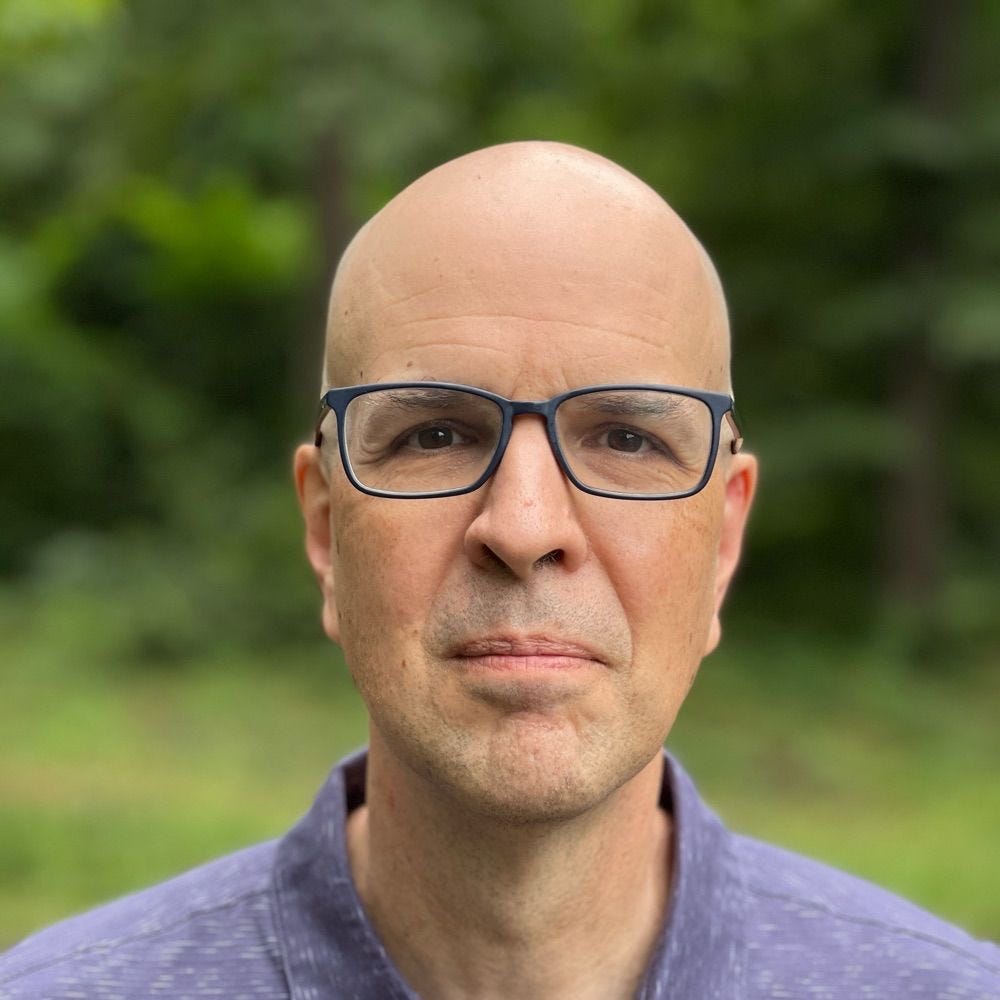
David Rachels has published short fiction in a variety of places in both the criminal world (Tough, Thuglit, Rock and a Hard Place, etc.) and the civilian world (North American Review, Sou’wester, Bombay Gin, etc.). As well, he has edited four volumes of Gil Brewer’s short stories, and he co-edits the Staccato Crime noir reprint series (all published by Stark House Press). He lives in Newberry, South Carolina, where he is an English professor at Newberry College.