

An interview with Mike McHone
Author of "The Suicide Disease"
Hello, Callers! Thanks for being here.
Mike McHone’s story “The Suicide Disease” marked a milestone as the author’s 50th published short story, and we couldn’t be happier that it found a home with Cold Caller.
Mike joins us today to talk about how he plots his short fiction, what keeps him going, and how his decision not to defenestrate a newspaper editor might have changed the course of his writing career.
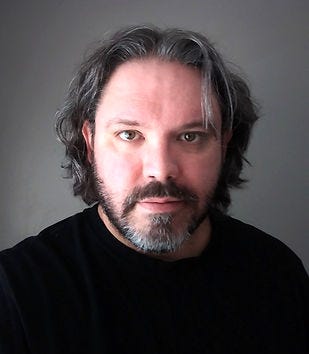
When did you first start writing fiction seriously? What’s your path as a writer been like since then?
The path has been a long, winding, potholed road filled with traffic jams. But it’s had some nice scenery along the way.
Between 2003 and 2014, I worked as a journalist throughout Michigan and Ohio. I also wrote dozens of short stories during that time but only sold a few. Back then, I wrote primarily science fiction, and I was in an odd space because I didn’t know if I wanted to be a fulltime journalist or a fiction writer.
Then, in 2014, I ended up working for a complete piece of shit newspaper editor. We got into an argument (I can’t remember what it was about) and I was going to throw him out of a window. Instead of going to jail for assault, I quit the job and stopped writing fiction for a couple years. I went back to fiction (obviously), but bailed on journalism. I’d rather unclog toilets and hunt and kill rats all day. Being a journalist is good training for that line of work anyway.
What draws you to writing crime and mystery fiction in particular?
Funny you should ask. In 2018, after the personal hiatus (so personal in fact, I was the only one who knew I took a hiatus), I picked up a copy of Ellery Queen’s Mystery Magazine on a whim. I’d never read EQMM before, and, in fact, I’d only read, maybe, eight or so mystery stories total. I never read Aruther Conan Doyle, Robert B Parker, Michael Connolly, Sara Paretsky etc., but I realized a lot of my sci fi stories had a mystery element to them, so I decided to just take the sci out of the fi and focus on the mystery. I wrote six mysteries over the next month and a half, and sold five of them to Ellery Queen, Alfred Hitchcock’s Mystery Magazine, Mystery Tribune, and Mystery Weekly. I couldn’t believe it. Still can’t. Neither can some critics, agents, editors, etc.
As far as gravitating to crime fiction goes, I think it’s easy to write that stuff considering I’m related to a few bikers, drug addicts, and scumbags, but, hey, that’s family.
“The Suicide Disease” is the longest story we’ve ever published, and yet the pacing is so good that I couldn’t help but tear through it. How do you manage pace in a story like this, both while writing and revising?
It ain’t the length, it’s how well you plot it. But, seriously, thank you. As far as the pacing, I try to keep in mind three essential things.
1.) Never let your main character rest for too long. They gotta keep moving, even if they’re only moving their mouth when talking.
2.) Beat, kick, annoy, frustrate, and irritate the shit out of them. Put them in a maze and let them figure it out. Maybe they’ll get out, or maybe they’ll get killed. Either way, fun!
3.) As far as the writing goes, if you can’t be entertaining, be profound, and if you can’t be profound, be funny, and if you can’t be any of those things, be quick and get the scene over with.
Samir is a complex protagonist, and after reading this story a few times I’m still trying to decide whether his brush with ‘the suicide disease’ made him an addict or whether it just gave him an excuse to self-medicate. How do you choose what to reveal and conceal about the inner lives of your characters?
Good question. I wish I had a good answer.
Really, I think it’s best if a writer doesn’t know their characters a hundred percent. I mean, would Samir have been an addict regardless? Probably, considering he (SPOILER ALERT FOR ANYONE THAT HASN’T READ THE STORY – AND IF YOU HAVEN’T, WHY THE HELL NOT?) starts chugging pills after his “friend” Kenny beats him. In fact, one person that read the story thought Sam willingly overdoses and kills himself. Maybe he does, maybe he doesn’t.
Some ends need to be open, and sometimes the best kind of sweetness is bittersweetness. If it’s too warm, let them feel a draft. If it’s too bright, give them sunglasses.
At what point in drafting this story did you have a solution for the central mystery? Is that where you start, or are you discovering the answers alongside your characters?
I don’t start a story unless I have an idea where it’s going. The ending I have in mind initially doesn’t necessarily need to be the ending that winds up being published, but if I have some kind of destination, the journey’s much more enjoyable. At least it is for me. I know some people hate that. They’d rather figure it out along the way. Cool. Whatever blows your skirt up.
However, I’ve written myself into a corner so many damn times that I’d rather forgo the frustration. I figured it’s best to have one complete thing than have a couple things lying around unfinished. I believe in what Ron Swanson once said: “Never half-ass two things. Whole-ass one thing.”
In our correspondence, you mentioned that this was your 50th published short story. How do you navigate all the ups and downs that come with that kind of track record? Do you have any advice for writers who are just starting out?
Drinking and drugs certainly help. It also helps to keep mind that failure is your primary product. Storytelling is secondary. Of all the stories, novels, essays, op-eds, poems, and jokes I’ve submitted, the highest acceptance rate I’ve ever had in a year was somewhere around thirty five percent, whereas the average rate is about twenty five. Those odds wouldn’t play in Vegas and only a fool would keep trying to win at a losing game, but I’ve never been much of a gambler and I was never any good at math.
I guess the only advice I can give anyone is that if you want this to be a career, treat it like one. You have to show up when you don’t feel like it, and all that nonsense. I had to quit writing for a little while to realize it, and to reassess my approach to all this. I had to fail at sci fi to realize I was a better crime and mystery writer.
Long (long, long) story short, it’s like anything. If you want to do it, you’ll make time. If you don’t, you’ll make excuses.
Who are the people who have made the biggest impact on your career as a writer?
If I start naming names, I’ll kick my own ass later for not naming whomever-the-hell, so I’ll just say if I corresponded through social media or email with anyone about beta reading, advice, querying or whatever regarding writing, believe me, they’ve made an impact. I know this is a copout, but honestly, there have been a shit-ton of people that have helped me along the way and I don’t want to leave anyone out.
What other projects are you working on that you’d like to share? Where can people connect with you or learn more about you?
I’m waiting to hear about a couple novel submissions, a novella, and a dozen or so short stories floating around out there. Nothing too out of the ordinary. Same old, same old.
As far as where people can connect with me, I’m on the usual bullshit sites. Instagram and X: @mike_mchone. Or visit my website: mikemchone.com. You can also find me waiting tables at Hooters in Toledo. Be sure to leave me a good tip.
Mike McHone is a Derringer Award-winning writer whose fiction has appeared in Ellery Queen’s Mystery Magazine, Alfred Hitchcock’s Mystery Magazine, Rock and a Hard Place, Dark Yonder, Mystery Tribune, Shotgun Honey, the Anthony Award-nominated anthology Under the Thumb, and elsewhere.
A former journalist, his articles and op-eds have appeared in the Detroit News, the AV Club, Playboy, and numerous other outlets.
He is the recipient of the Mystery Writers of America’s Hugh Holton Award, placed twice on Ellery Queen’s Annual Readers List, has been nominated for a Pushcart Prize as well as a Best of the Net Award, and was cited on the Distinguished List in 2024’s Best American Mystery and Suspense. He currently lives in Detroit.
Never let a Mike McHone story pass you by ....
M.E. beat me to the punch with her comment. Could not agree more on the writing talent of Mike McHone. Really enjoyed this interview. - Jim