

Harvest
Fiction by Carson Winter
Hello, Callers. Thank you for being here.
Today, we’re thrilled to feature new fiction from Carson Winter about a trio of siblings who do what they must to survive among the hardscrabble farms of the heartland.
Can you blame them if they’ve learned to enjoy it?
Harvest
We always sent Kristy up first because the older folks thought she was cute. Me and Lars would wait back by the peach trees or hide in the blowing wheat or, sometimes, just throw rocks down by the creek until she came bounding back with a smile on her face, the black space bold between her front teeth, yelling, “I got ‘em, I got ‘em.”
Lars wouldn’t smile back, not at first, he was always tough about that. But he was the oldest too. Almost sixteen. He’d get right down to business. “So, what? They got guns?”
Kristy nodded.
“Well, that’s good, I guess.”
I thought it was kinda silly that he played it so serious. They always had guns. Every single one of them. You couldn’t have a farmhouse out in the middle of Bumfuck, Nowhere and not at least have a shotgun. And most of them had more than that. A couple revolvers, maybe heirlooms passed down from God Knows Where, or a hunting rifle with a shiny expensive scope that glints like a teary eye. But still, I guess Lars took some pleasure in the process.
We were walking down the dirt road, listening to what Kristy had to say about the whole thing.
“They keep ‘em in a cabinet. It’s right inside the living room.”
“They have a name?”
“Mrs. Kolshak, was the woman. I guess the man’s name is Mr. Kolshak.”
Lars shook his head. “We don’t need to know their names.”
“They have any kids?” I asked.
“Yeah,” said Kristy. “Two of them. A boy and a girl.” She paused like she was afraid to go on further and say their names, so she kept her mouth shut.
“How old?”
“The boy was younger than me. Just a baby, really. He was sitting on the couch in jammies watching TV while Mrs. Kolshak went and got me some water. Maybe seven years old, I guess.”
“And the girl?”
“About Brett’s age,” she gestured toward me. “Maybe a year younger. Twelve or thirteen, if I had to guess.”
“What was she doing?”
“Nothing really. She didn’t pay me no mind. She was at the kitchen table with a book out, like a school book, and I think she was working on that.”
“I don’t know any girls with the name of Kolshak though.”
Lars slapped me on the back of the head. “You haven’t been to school for two years. What do you know?” He thought about it some more. “But maybe she’s homeschooled. Lots of country folk do that.”
Sometimes it was best to let Lars think it was his idea.
Kristy said, “It was an old house. I told Mr. Kolshak that it was beautiful. He told me it was his great grandfather’s and that they just did their best with it.” And then, as if predicting Lars’ next question: “They let me use the bathroom. It was one of those old ones with a chain string. I didn’t see any bedrooms on the main floor.”
“You didn’t go upstairs?”
“No, didn’t feel right.”
“Probably all the bedrooms are up there, makes sense to me. Some of them old farmhouses have a master bedroom on the main floor though. You sure you didn’t see anything like that?”
Kristy shook her head. “Nope. Just a bathroom, living room, kitchen, and dining room.”
“They got a basement?”
“I don’t know, I didn’t notice a door to one.”
“It’s a cellar,” I said, helpfully. “When we were coming around the bend I saw the doors to it outside.”
I thought Lars looked mad that he hadn’t seen it himself. “Fine, a cellar then. If the door’s on the outside they probably don’t go down there much for anything.”
“They seemed really nice,” said Kristy. “The mom was sweet. She gave me the water and asked where I lived and I told them exactly what you told me to.”
“You sure?”
“Yessir,” she said, her voice high and girlish. “I told them that I lived out a couple miles back in town, but that my Daddy and I were out fishing in the creek, that he brought himself a beer and forgot to bring any water for me, and that I was very thirsty and he told me to kindly knock on the door and ask if the good folks in the house would spare a glass for me.”
“And they bought it? They didn’t ask to talk to him?”
“They did, but I told ‘em that he was busy. He’d been fighting with a catfish all day. One of those big hundred-pound ones and he wasn’t going to let down the fight. They seemed to like that. Mr. Kolshak even told me to tell him ‘good luck’ when I left.”
Lars smiled. He reached out and mussed her hair. Kristy had done this enough times now that there was no need to worry. She hit all her marks.
“What do they grow?”
“Corn, just plain old corn.”
I turned back to look at the farmhouse. It was just a dot now. We followed Lars through a bramble, hopping rocks over a stream, before we talked it out all over again.
*
We never went in order, because that would give it all away. You see three kids, each one older than the other, and people get to thinking something’s up. Lars always said, “It was too much like a fairytale.” Something about the three little pigs, or Goldilocks. Lars was very aware of patterns. I knew this because he would talk about them all the time. He would warn us against them.
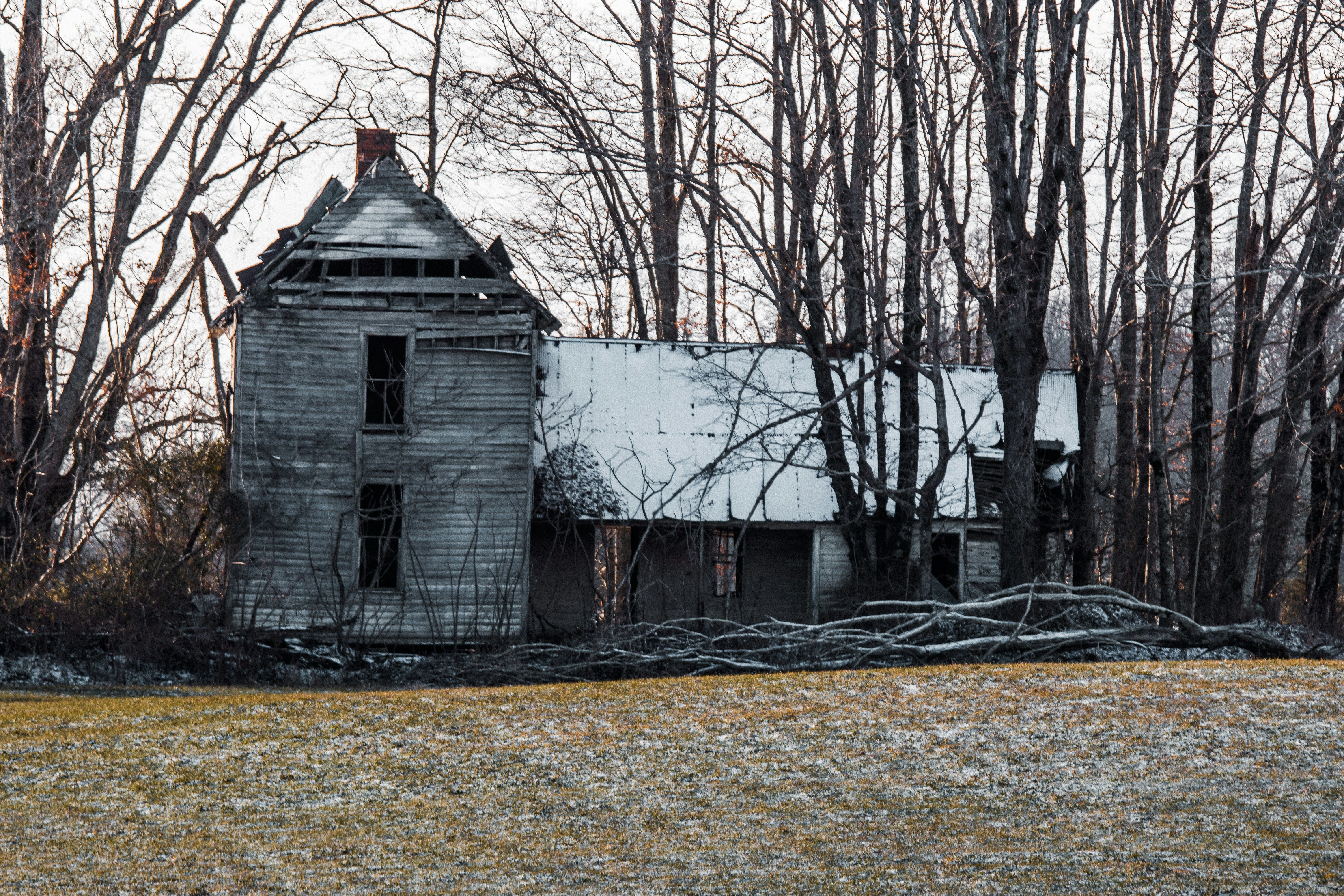
The house we lived in wasn’t really a house anymore, but it held up for the most part. The roof had sunk in and the furniture had all been eaten by rats. Plaster and paint chips were all over the floor, but it more or less kept us safe from the elements. We figured we’d have a couple more good years in it, but it was hard to say. I think Lars was always hoping against hope that it would stand longer than it should.
What was good though was that it didn’t attract attention. There were lots of poor folks out in the woods, living on old land. Crumbling houses were in lots of overgrown fields, next to the new supermarkets and just a short walk from the downtown too. You couldn’t escape the things.
Lars stood up from the couch. He hadn’t drank at all today. He knew that people thought ill of kids who drank, so he always sobered up before he had to do his part.
Still, I could tell he was irritable about it.
“You two going to be alright here without me?”
“Yeah, we’ll be fine.”
“Don’t let her go running off now.”
“I ain’t never gone running anywhere,” said Kristy, pouting.
Lars sneered slightly, then turned toward the door. “No telling how long I’ll be gone. Could be an hour. Could be all day.”
“We’ll be fine,” I said.
“Sure, yeah.” He didn’t believe me, but we always were.
When Lars left, me and Kristy sat around. I’d bought a book from the Goodwill in town and sat back reading it, or pretending to, as she bounced around the main floor of the house with her dolls, making up conversations as she went from room to room. Kristy was always full of imagination and stuff. She liked to make up stories, but I guess we all did.
Hours passed quickly. Lars wasn’t back, which I think meant it was going well. It’d been a week since Kristy made her visit, but not quite a week. Eight days instead of seven—something Lars always made sure of, so they wouldn’t make any connection between the little girl who asked for a glass of water and the young man that came by to ask for summer work.
Kristy had gone silent. “What are you doing?” I called.
“Nothing.”
“Too quiet to be nothing.”
“I’m not doing anything bad.”
“Alright then, prove it.”
Her footsteps creaked floorboards, I followed her around the house with my ears, and suddenly she was in front of me. “See? I’m just here. I was playing quietly.”
“I just wanted to make sure you weren’t getting into trouble.”
Kristy rolled her eyes. I wasn’t sure where she learned it but if Lars had seen her do it he’d have slapped her.
I threw the book onto the couch and a plume of dust erupted from the cushions. “What do you want to do?”
“What do you mean, what do I want to do? I was doing it.”
She was going to make me spell it out. “I’m bored.”
“Lars says that the only people who are bored are boring.”
And before I could think about what I was saying, it slipped out of my mouth. “He just learned that from Mom.”
Kristy cocked her head, no doubt trying to figure out if we could talk about it or not. I moved on quick. “Maybe we could play cards. You know how to play Go Fish, right?”
She nodded slowly, her eyes big and glassy.
“Go get the cards,” I said. “Let’s play until Lars gets back.”
Kristy did as I said and I turned my eyes toward the upstairs, the sinking ceiling above our head, and I felt like summer turned to winter in the length of a breath. I shivered and tried to look at something else.
When Kristy came back in, I pretended I was fine. She sat on the floor and crossed her legs, shuffling in that slow, clumsy way that kids do. We played fifteen games and she didn’t speak out of turn. I won most of the games, but by the end, I’d gotten tired of winning and let her have a couple too, as if to let her think she’d got a handle on it, but then at the end, I won the last couple too, because I didn’t want her to know that I’d let her win. Switching up the pattern and all that sort of stuff.
When Lars finally returned, he was dirty and exhausted, his eyes had glazed over. I heard him moaning outside for about a quarter-mile before he even got to the door. Kristy was asleep on the couch, and I only knew Lars was coming because I’d already been trying to listen for the rats that were scurrying up and around upstairs.
“How’d it go?” I asked.
“It went.”
“You look tired.”
“I’m exhausted.”
He moved Kristy to one side of the couch and sat down on the other. She didn’t stir. He threw his head back and yawned.
“You grab me a beer?”
“Sure.”
We didn’t have electricity in the house so when it was dark it was just dark, but I’d lived here all my life so at a certain point you didn’t need it. I went to the kitchen and grabbed two beers from the pile on the floor and brought them back to my brother, who was rubbing his eyes.
He cracked open one and drank it in one long chug, then gestured for the second, which he sipped.
“Long day,” he said, finally.
“You think it’s going to work out?”
He sat the beer on the armrest. “I’ll tell you about it in the morning.”
I nodded in the dark, listening to the rats upstairs. Before long, I was listening to Lars’ snores as well.
*
We like to get out of the house when we can, so when Lars woke, he grabbed a six pack of warm beer and told us to go to the river to talk about the last day. The river wasn’t more than a creek, but there was a wide spot in it that cut through this prairie that we liked, and right there it looked more like a river than anything else. Kristy balled her fists and dug them into her eye, to get the sleep out of them, meanwhile Lars looked like he’d been awake for hours.
We sat on a log and he gave us a can of beer. He pointed to Kristy, “Only a little for you.”
He didn’t need to worry about her. She couldn’t stand the taste. I cracked it open and took a long deep pull and passed it to her. Just as I thought, she took one little swig, grimaced, and handed it back.
“So, what happened?” I asked.
“It went well. I met Mr. Kolshak. He gave me ten dollars for the day, which was better than I thought.” He drank his own beer, staring out at the rushing water. “I spent most of the day cleaning out and repairing some chicken coops. It was hard work but they all seemed to appreciate it.”
“Ten dollars,” I said. “You could make a living on that, couldn’t you, Lars?”
“More or less.”
“Can we get some sweets?” asked Kristy.
“Easy there, you know that’s not why we’re here.”
“What do you make of the farm?”
“Like Kristy said, mostly corn. The chickens are just there for eggs. It’s big though. A lot bigger than ol’ Mr. Westerhaus’. So it’d take more time, I think. More planning. We couldn’t get it all, but maybe enough to make it all stick together. I’m thinking we should aim for half.”
“How long till the corn is up for harvest, do you think?”
Kristy reached for my beer and made another sour face.
“Not more than a month or so out. They’re pretty young as it is. He didn’t mention anything about no money problems, but the way the house is held together, I figure they have just enough and none more.”
“You went into the house?”
He shrugged. “Just for a minute or two. They gave me some lemonade and a ham sandwich at midday. One of the doors has a broken hinge and it’s being together with a screw and not much else. The oven is old.” He smiled then. “I did get him to talk guns with me though.”
Lars knew I liked all the talk about guns. “Well, go on then.”
“Nothing too fancy, but he’s got a pistol. A Colt that he brought back from the war, along with a shotgun to shoot varmints. He said they don’t get too many these days. I acted all interested, told him my Dad used to have a Colt and that it was a fine firearm and one of these days I want to get one for myself.”
“What’d he say?” I asked, taking a drink.
“He didn’t say much,” he said. “But he did let me hold it.”
“Really?”
Lars grinned. “He did. I held it like this.” He closed one eye, his hand up in front of him. “And handed it right back to him.”
Kristy wasn’t nearly as interested in the gun talk. “What about the kids?”
Lars’ eyes turned hard. “What about them? You saw them first.”
“What are their names?”
“Esther and Matthew.”
“They go to school?”
“Matthew’s too young. Mrs. Kolshak teaches Esther at home.”
Kristy beamed at that bit of knowledge, no doubt proud of her own deduction.
“So, what next?” I asked.
Lars thought. “I told him I’d come back with you next week to see if there was any work. He can’t pay out every day, but he said if I came back with you he might have something for us.”
We spent most of the day at the river, slowly getting drunker. Even Kristy, from her little baby sips, started getting tipsy and splashing in the water. Lars was in a good mood, I could tell, because he was laughing at her, telling her to drink more. Even when she threw up, he wasn’t mad. He just went over and pulled her to him, gave her a hug, and told her to lay in the sun.
After a while, he said, “We best get to town today, to pick up some supplies.”
I was buzzed, just as he was, but we’d sober up on the way.
Kristy said, “Just a little longer.” She was basking like a cat. “It’s so nice out here.”
*
In town, we were more or less invisible. Lars did all the talking. Kristy and I got some Cokes and mostly just hung around. When he came out of the farming store, the vacation was over.
“Finish that,” he said. “Take this.”
He handed me two of those crop sprayers, the handheld kind. He had two big old plastic buckets, plain white, in his other hands.
I threw my drink away and did what he said. His arms swelled from the work of it.
No one looked at us because we were just a bunch of kids. Even in small towns, kids don’t matter. The farmers sent their kids in all the time, half of them didn’t ever go to school. And they kept making more of them. The town was growing, they’d always say, but somehow it stayed the same size. Sometimes, I thought what we were doing was good because of that. Not just fun, but like a moral right. We were keeping things in check, lest it all get out of control.
But then again, it’s not like people didn’t know us. The man at the farm store remembered Lars’ name, always asking if he was keeping care of us. You could be known and still be invisible.
From the sidewalk, we made it back to the road, and then the paved road became a dirt road and we were back into the wilds, where the trees got thick and nasty and you could hear the bugs buzzing in the air, vibrating it.
It was a good day. We had a lot of good days.
*
“Brett, come here and give me a hand,” he said.
He was trying to tip one of the buckets into the sprayers, but was spilling it all over the floor.
I ran over and tipped the bucket, steadying it. “Good?”
The milky liquid filled the hopper. He screwed the top of it and motioned for me to ready the other one.
“Is this gonna be enough?” I asked.
“No, I reckon not. But we can carry one of these buckets with us for a refill. Might be the best way to do it.”
“Will that be enough?”
His eyes turned sharp. “You sure are asking lots of questions. You doing this or not? You gone soft?”
“I haven’t even met them, Lars.”
He reached out and slapped me and I took it without saying a word. When he was done gritting his teeth, he pushed one of the sprayers into my hands. “We don’t need to get ‘em all. We just need to get enough, alright?”
I nodded. The sun was setting. Pink light creeped in through the windows.
“Kristy?”
“Yeah?” She was kicking her feet on the couch.
“You gonna be okay here alone?”
“Yeah,” she said.
“You just go to sleep and it’ll all be alright.”
“I know.”
“I don’t want to see you anywhere but on the couch when I get back,” said Lars.
“I know.”
He turned to me, as if I had already done something to fuck up the night. “I’m going to have a beer or two,” he said. “This is supposed to be fun, after all.”
I sat beside Kristy on the couch, waiting for the sun to fall below the horizon, then fall further still, as if it were pushed into the black of a well, drowning in brackish water.
At around midnight, Lars was good and drunk, and I was too, at least a little. On his second beer, he began to cheer up, and he offered me one, and then another.
Kristy’s head was on my lap. She’d fallen asleep reading a picture book.
“They should be asleep now,” he said.
I got up slowly, putting my hand under her head so it wouldn’t drop too fast.
“Don’t worry about her,” said Lars. “She’ll be fine.”
I wasn’t worried, but I nodded as he handed me the sprayers, and he grabbed one of the buckets.
Wordlessly, we made the trek to the Kolshaks’ farm. Out here, in the middle of nowhere, it’s black at night, except for the stars and the moon, but there wasn’t even that. Clouds had rolled in and the only hint of light was what bled through the wispy edges. Good thing though we’d walked every inch of these roads, trails, and creeks. Lars had gone up and down these paths since before I’d been born. He’d say that he could do it all blindfolded if he needed to. I always thought that was some bullshit, but now he was doing just that.
The farmhouse had one porch light that shined in the night, giving it a soft, yellow glow. That’s how we knew we were at the right place.
Lars said, “Are you ready?” I could hear the smile in his voice.
It was contagious. “Yeah,” I said, as I handed him his sprayer.
“We’ll do it on different sides. We go down the rows and meet in the middle, or until we run out, got it?”
“Alright,” I said.
With that, Lars ran to the far side of the farm, disappearing into the dark. I wondered if Mr. and Mrs. Kolshak were asleep in bed, or if they were up late, reading. I wondered if their littlest was snuggling between them like Kristy used to do. I swallowed the thought down and began walking the rows.
It was easy work, relaxing work. This was really the best part of all of it because we didn’t have to wear our masks. We could just be. We didn’t have to be around each other. There was no brother-brother thing happening, it was just me and Lars, walking around, spraying the stalks and leaves, thinking. It was even better because it was so dark out. It wasn’t like it was daytime where the whole world could see us. It was better like this. We didn’t have to tell ourselves we were invisible, because we actually were.
I felt the cool night air on my face, the remnants of alcohol still pumping through my veins, and I couldn’t help but think that it couldn’t really get much better than this. That this was the life. I’m sure Lars felt the same way. I didn’t think he asked for this, even though he kind of did. Being the older brother, more or less raising us. I think that’s why I was so forgiving of him, even when he was being an ass. I knew that deep down he was doing his best, and if I were him, I’d be enjoying the feeling of being unattached. Of disappearing into the dark, with nothing more than a body and the thoughts swirling inside of it.
I made it through about a dozen rows before I had to go back to the bucket. Lars was waiting for me, already refilled.
“You can use the rest,” he said. Not loud, but not a whisper either. We were far enough from the farmhouse that it was like the Kolshaks might as well not have existed either.
We did the rest, never quite meeting up in the middle, but I could hear Lars by the end of it, his heavy footsteps plodding about, always another four or six rows away from me. When my sprayer was empty, I met him beside the road, sitting on the empty bucket.
He seemed giddy. “We got more than I thought,” he said.
“Much more,” I agreed.
“They won’t know what hit them.”
“No, I reckon they won’t.”
The clouds parted and a silver ray of light illuminated Lars’ face. I couldn’t tell if he was laughing or crying.
*
Most of the time, we didn’t think much about the past. Lars made sure of that. He was all about freedom, and for him, freedom meant moving forward. He said that if we were gonna waste our lives with history, we might as well be dead already.
But it was inevitable sometimes.
When we got back, Kristy wasn’t on the couch and the first thing Lars did was turn to me, eyes like embers, as if he was accusing me of something.
“I was with you,” I reminded him.
He hit me once, upside the head. “I know that.”
We didn’t say anything else, we just looked for her. Lars packed batteries into a flashlight and went outside beaming his light around, yelling her name.
I just went upstairs though, because I figured it was obvious where she went.
We never went up there, probably for good reason. While Lars was outside, scanning the treeline, I went up one foot at a time, afraid of what I’d find. I tried yelling for him, but it came out at normal volume. I didn’t think he could hear me over himself. “Lars,” I said. “I betcha anything that she’s right up here.”
Well, with each step, I started proving myself right, which was an awful feeling, because I didn’t fully want to see what was happening up there. Each of us were different and the same. Lars wanted to forget about the upstairs, to treat it like a discarded rag. Kristy was endlessly curious about what was so secret, even though she knew all about it. And then I was somewhere in between. I was old enough to remember the night that changed our lives. And I was young enough to wonder about it too.
Lars must have seen me through the window because the door slammed open and he said, “What the Hell are you doing?”
I just looked at him.
“Why’d she go up there?”
“Why do you think?”
He dropped the flashlight to his side, maybe just not getting it. “I don’t know why anyone would go up there.” But he didn’t stop me. He just stood at the foot of the stairs.
My legs started wobbling a little bit with each step, but now that Lars was watching me, I knew I couldn’t be afraid. So, I went a little faster, stepped a little harder. “Kristy?” I said, trying to keep my voice even, lowering it to seem more like a grown-up.
At the top of the stairs, I saw exactly what I didn’t want to see. There were three doors here. Each of them closed tight, usually. But that night, there was one that opened just a crack. It was like the opposite of when a door is open and light beams out of it, making everything bright. This room looked like it was leaking black.
I pushed toward the door, my heart pounding in my chest.
Lars, from the bottom of the stairs. “She up there?”
I didn’t answer. I just let the smell hit me.
It didn’t smell like what I thought, which I was glad for. It smelled sour, sweet, but not like roadkill. Maybe like a whiff of it, but mostly it smelled old, like history. Mildew and stuffy air.
The moon shined through the windows and I could make out the bed.
“What’s going on up there?” called Lars.
They were both still in there—under the covers. The sheets were brown now, but they didn’t look like people no more, they’d been changed. Skulls with black holes for eyes, their flesh and blood having soaked through and dried into the bed. I couldn’t tell them apart either. Ma and Pa looked more or less the same. I know I had Ma, because I was smaller. But it was like a dream now. Who’d I cut? I don’t know. I remembered it different every time.
But she was there, betwixt them. Snuggled up, sleeping, snoring into their bones.
“She’s here,” I said, loud enough for Lars to hear.
“Is—is she okay?”
“Kristy,” I said. “Kristy, you can’t be up here.”
She stirred in between them, then turned to me, blinking in the darkness. “Brett?”
“Yeah, it’s Brett. You shouldn’t be up here.” My legs didn’t want me to get closer to the bed, but I did it anyway, trying not to shake. I reached down, feeling my flesh ripple as it scraped against Ma and Pa’s bones, sliding my hands under Kristy to pick her up. I held her to my shoulder, where she laid her head down.
I closed the door behind us.
“She okay?”
“She’s okay.”
“What was she doing?”
“Sleeping.”
I put Kristy down, letting her stand on her own feet. Lars got down to her level. “Why’d you go and do that?”
“I woke up and couldn’t sleep.”
“And you wanted to go up there and give me a heart attack?”
Her head dropped, she stared down at the floorboards.
“You shouldn’t be going up there. It’s just not safe,” he said.
“Okay,” she murmured.
“Go back to the couch, get some rest. Jesus Christ.” He rubbed his eyes and let out a long sigh. “We’ll talk about this in the morning.”
But we never did.
*
Lars wouldn’t let us go back, not right away. It would create too much of a pattern. “We don’t want to look like vultures. Because we ain’t vultures. We’ll let them go on about their business and we’ll go on about ours.”
So, in the next couple of days, we went to town. We drank sodas, fished, skipped rocks, drank beer, and read stories out loud to Kristy.
And every once in a while we heard the whispers of the latest tragedy. But no one put it together. The other was a fire—a freak accident. Before that it was bad poultry. And you can’t blame anyone for burning up or eating rotten meat. Sometimes those things just happen.
*
Four days later and we were standing down the road, looking up at the Kolshaks’ farmhouse. Kristy was with us this time, for obvious reasons. Lars grabbed me by the shoulder and said, “Now, remember, we don’t get to take a bite yet. We’re just cooking. We’re pulling the roast out of the oven and we’re checking to see if it’s ready. We’re cutting to see if it’s still bloody. Maybe it is, maybe it isn’t. But we’re just seeing if they have some work for us. Maybe they will, maybe they won’t. We don’t get surprised either way. You ready?”
“Yeah. I’m ready,” I said.
“Good,” said Lars. Then to Kristy, “I don’t want you going anywhere. You stay right here, out of sight. Don’t you go anywhere or I’ll beat the snot out of you.”
Kristy furrowed her brows but sat down at the trunk of a tree, arms around her knees.
“That’s good,” he said. “That’s exactly how you should be.”
Leaving Kristy behind, we walked up to the door and I focused real hard on keeping a hungry expression on my face. We were supposed to say that our family had come on hard times and we needed to get out there and work. So I had to look eager, enterprising—like someone who’d lick the shit from the devil’s ass if it meant getting some soup and a slice of bread.
Lars knocked on the door. I held my breath. It was only a couple seconds until the woman I figured was Mrs. Kolshak came to the door. She was pretty, younger than I expected, but tired looking. “Oh, hello, boys.”
“Greetings, Mrs. Kolshak,” said Lars, putting on his best radio voice. “We were in the neighborhood and wondering if Mr. Kolshak was around.”
She took a deep breath. “Give me a second, boys.” She added, “He’s still in bed.”
Lars warned me not to react, so I didn’t.
Mrs. Kolshak left the door open as she went upstairs, and I could peer into the house. It was a normal-looking farmhouse, a little old, but homey. The kitchen was small, the dining room smaller, and the living room was covered in photographs. On the couch was a girl about my age. She looked up from her book, raised a curious eyebrow and asked, “Who are you?”
“Hello, Esther. We’ve met once before. I helped your father with the chicken coop. I’m Lars. And this here is my brother, Brett.”
Her mouth opened in recognition. “You best be getting along then. There ain’t no work here.”
“Why’s that?” I asked. The words came out so fast that I was thankful Lars didn’t hit me.
“Daddy said the corn turned brown and died. Not sure why. Might have been poisoned. Momma said it might have been God.”
“No kidding?” Lars shook his head. “That’s a damn shame. If there’s anything at all we can do—”
“There ain’t nothing you can do,” said Esther. “Momma’s going to the food bank. We might be eating air this winter.”
“You can’t have run out just yet,” said Lars, credibly incredulous.
“Daddy says we got to ration until we get our feet back under ourselves.”
I nodded. “That makes sense.”
Mrs. Kolshak came down the stairs. “Sorry, boys. Henry isn’t feeling well. He says maybe come back in another week.”
Lars bowed slightly. “Of course, Mrs. Kolshak. Give Mr. Kolshak our best.”
On the way down to the road, Lars was all smiles. “You taste that? Well done.”
*
The next night, Lars lit a candle and we all said a little prayer. Kristy was too young to take part in the main event, but she was still in on the prayer. I don’t really know if she knew what we were doing or how we were doing it. I don’t know if she knew what happens after we die. But she closed her eyes and if she tried looking up to the ceiling, I couldn’t tell.
Lars said, “This bounty is a godsend. Freedom is a godsend. But freedom don’t last forever. Not for them, not for us. There’ll come a day, and I rightly don’t want to imagine it, but there’ll come a day when we aren’t together no more. Because things don’t last. Not people, not this. And we won’t get to be free together forever. So it’s up to us to treasure it while we have it. No one telling us what we can and can’t do, no one on our asses about anything. That’s what this is all about. And one day they might take us all away, split us up, or Hell, maybe they’ll strap us each into an electric chair and fry us. A small one for Kristy, of course. Because that’s what they do to people, and for at least a little while, we don’t have to be people. So, I want to enjoy this moment for you all, enjoy our harvest, because besides each other, it’s all we got. Amen.”
“Amen.”
“Amen.”
*
The harvest takes weeks of planning, and we’re all jittery right before, but it’s like anything—over in a flash.
Lars went to one room, I went to the other. We staged them up real nice. Made sure that Mr. Kolshak had the shotgun right at his chin.
When it was all done, we sat in the quiet for a minute, listening to the dead leaves blowing through the corn. Musical, almost.
“It’s great out here,” he said. “I love the quiet.”
“Can’t get enough of it, sometimes,” I said.
And we sat like that until the morning broke, until the tractors started rumbling, until the roosters started crowing, until everyone was up and about. In a day or two, they’d get wondering about the Kolshaks. And then a day later, they’d knock on the door, listening, and hear nothing. A fat sheriff who smelled like cigars and bourbon would pull up and his boys would break down the door, but they’d have the story before the smell even hit them. All you’d have to do is look out at his field and see the wilting leaves, the bent stalks, how brittle it all looked.
That’s how these things happen. Lars was right about there always being a pattern. We just exist in it until we don’t.
Carson Winter is an award-winning author, punker, and raw nerve. His short fiction has appeared in over 20 publications, including Apex, Vastarien, and Chthonic Matter Quarterly. He is the author of Soft Targets, The Psychographist, and A Spectre is Haunting Greentree. He lives in Saint Paul, Minnesota. Learn more here.
Damn this is great!
Wow, that was one wicked tale that just sort of creeps up on you.