

In the Ruins
Fiction by Nick Guthrie
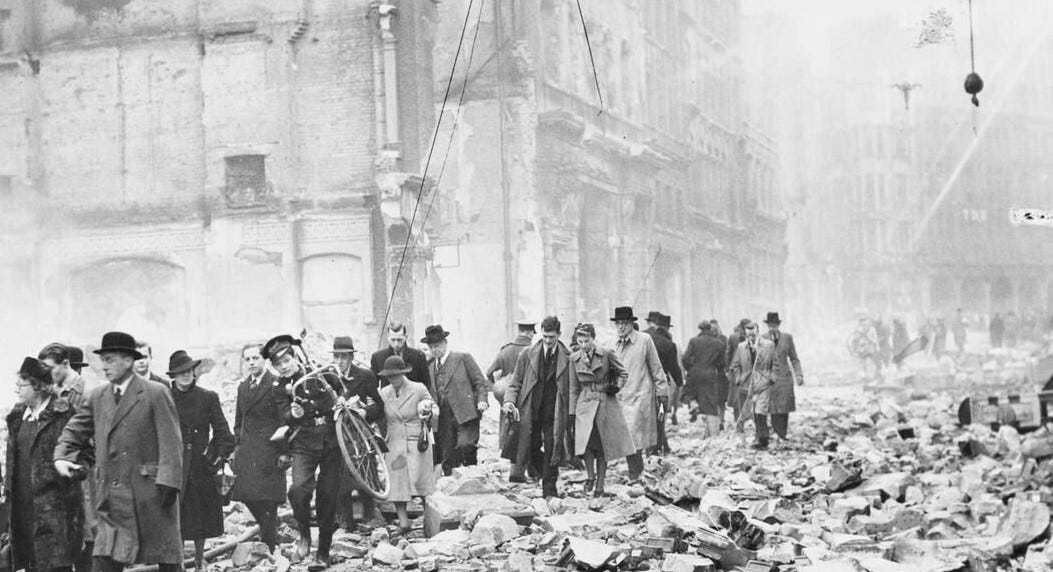
In the Ruins
When the bomb went off, Lenny Tunnicliffe nearly lost his leg again, but instead he found a body.
Tunnicliffe, a tall figure in flimsy bluette overalls, white helmet and ARP armband, was walking the darkened streets just the same as any other evening of the last fortnight since war had come to the skies of London. He paused to peer around, using the break as an excuse to adjust his leg. Windows were covered with beaverboard, cardboard, and blackout curtains, and the only light came from the baffled headlights of an occasional passing car and the eastern sky aglow with burning buildings. The repeating rise-and-fall wail of the sirens was not enough to mask the steady drone of the bombers, the rattle of anti-aircraft guns, and the occasional visceral thump of an exploding bomb.
Some of the buildings here on East Lane had been hit a few days before, holes gaping in the terraced rows, houses showing their secrets to the world in the gloom like tarts flashing their knickers. Exposed walls with paintings still hanging, sofas and beds balanced precariously on floors tipped at gravity-defying angles, orphaned staircases clinging to walls and leading nowhere.
A small group appeared at the street corner, clutching blankets and cushions to their chests. “Hurry along, Mrs. Purves,” Lenny told them, addressing the woman shepherding the group like a mother hen. She was always among the last to take cover. “Best get yourselves underground. Looks like it’s going to be another long night.”
“Thanks kindly, Lenny. You watch out for yourself too, you hear?”
“Ta ta for now.” He waved them on their way, then heard raised voices, turned around, and saw figures moving in the shadows, and then a girl, or perhaps a young woman, running away. He had time to wonder what her game was, and then the bomb hit, no warning, no wail of its descent, just a sudden blast that deafened him and shook the ground like an earthquake.
He fell, catching himself just before his face hit the ground, then braced, not knowing what might come down on top of him. For a moment his mind took him back to Northern France: the banshee wail of a diving Stuka becoming a blast that turned the world upside down and then, afterwards, lying in the crater, his best pal gone along with the lower part of his right leg.
He rolled over and tried to sit, but there was something wrong. Perhaps a couple of streets away, another bomb struck. The night was young, and this would go on for hours yet – no respite, even when you’d just survived a miss as near as this had been.
His ears were still ringing, and his mouth was dry and full of grit.
He reached down to tug at his trousers, found leather straps, wood. The prosthetic had come loose, and the stump throbbed. Cursing his useless limb, he pulled the false leg’s leather sleeve back into position over his stump and tightened the straps, despite the pain.
He stood and took a staggering step, but the fitting wasn’t right and the thing wouldn’t take his weight. With a cry of pain, he fell forward.
That was when he found the body.
He caught himself on a mound of rubble, his face against stone but one hand grasping at something softer, smoother.
He pushed himself up on his elbows and saw a face, skin white like porcelain, dark eyes wide to the night. A youth, buried in the rubble. Blond, almost angelic in this hellish scene. Lenny fumbled for the torch at his belt and let it flare briefly, the light shielded. A dead boy. Those eyes staring blankly and stirring the very worst of memories.
He heard a cry then, a woman begging for help. Somewhere in the ruins nearby.
He straightened his helmet, tightened his leg straps once again, and forced himself to stand.
The bomb had taken out at least four houses here, reducing them to towering heaps of rubble and roof timbers. Only the back walls of one house still stood, just about visible in the gloom, blackout cardboard still fixed to the windows.
He saw a white-haired woman scrabbling at the rocks with her hands.
He went across and put a hand on her shoulder, trying to calm her, stop her.
“He’s gone,” he said. “It’s no good.” Even without the torch he could see an old man’s motionless form lying in the ruins, partly covered by fallen masonry. For a moment the woman persisted, then she rocked back on her heels and gave an agonising cry, before turning and burying her head in Lenny’s chest.
He persuaded the old lady to come with him, back to the junction and along the street in the wake of Mrs. Purves and her group. Another bomb struck somewhere nearby, close enough to shake the ground and leave Lenny and the woman staggering against a wall.
They came to the entrance to the Tube station and Lenny nudged the woman ahead of him. The stations had been used as shelters for some time now, but it was only in the last few days that the authorities had given formal approval.
“Come along, now. You too, Tunnicliffe. Might as well take cover while you can.” That was Arthur Blake, his belly bursting out of the police constable’s uniform that had come out of retirement with him when most of the younger coppers had gone off to the Front.
“I… I did what I could, but…” Lenny gestured back along the road.
“I’m sure you did, Lenny. I’m sure you did your duty, son.”
“I did. But, Mr. Blake, now it’s time for you to do your duty. There’s a body. A boy.”
“There’s always bodies.”
“But this one wasn’t a bomb victim, Mr. Blake. Someone murdered him.”
#
Tunnicliffe spent the night in the underground shelter, hunkered down by the rails. PC Blake had refused to go back with him to search for the body, said it was madness and, as if to emphasise his judgement, while they were discussing the matter another bomb had struck the row of shops across the road from the Tube station entrance.
That night was the worst yet, in more than two weeks of bombing. Sleep was impossible and anxiety and tensions were running high, the confined space even more crowded than usual. Lenny soon gave up on sleep and joined PC Blake and a couple of others patrolling the platforms, threading their way through the gaps with an encouraging word here, a smile there, and their presence seemed to have a calming effect.
As dawn broke, Lenny took PC Blake aside and said, “Come with me. There are at least two bodies on East Lane anyway, and there might be survivors in the rubble. We may as well start the morning searches there as anywhere else.”
That had become routine, too, the morning reconnaissance, looking for the bodies and the wounded. The city coming back to life as families returned to the ruins of their homes and recovered what they could of their lives. The looters, too, because where there was suffering and loss there were always those who might profit.
East Lane was steadily being erased from existence. Yesterday there had been a gap of four houses; by this morning another half dozen had been reduced to rubble. Even walking along the street was a risky business, with bricks and other debris piled high all around.
“You okay, Tunnicliffe?”
PC Blake meant well, but Lenny was sensitive to any suggestion he couldn’t do his bit. He didn’t need special treatment, and he’d suffered far too many barbed comments about it being a mistake to let a cripple do important war work.
He strode ahead, praying that his leg wouldn’t betray him right now.
Halfway along East Lane, he paused to get his bearings. Everything was so different this morning.
Across the street, a group of women pulled at collapsed masonry in one of the ruined homes. It was hard to tell sometimes if they were legitimate householders or looters. Blake was watching them, too, clearly wondering where his priorities lay.
They found the old man first, lying with his knees drawn up to his chest. Tunnicliffe made a quick examination – he’d been in the Royal Army Medical Corps before his war had ended. “No obvious cause of death,” he told PC Blake.
“Heart?”
“Maybe.”
The constable recorded the location in his notebook so they could get someone out to take the body away.
Lenny straightened, forcing himself to relive those moments from the previous evening. He turned, took a few steps, and pointed at a heap of rubble. “Here,” he said. “The boy was somewhere over here.”
It was a thankless task searching for anything in this mayhem, even when you knew what you were looking for. Resisting the urge to start hauling at the fallen brickwork, Tunnicliffe studied the mess.
Here. This pile. He closed his eyes, remembering the sensation of flailing in the darkness for balance as he stumbled, of his hand closing on the softness of the boy’s face. The lukewarm, waxy feel of it, so wrong for something that should have been warm and living.
He opened his eyes and saw the porcelain white skin now shaded grey with dust, the eyes still staring, betraying their secret. A boy, adolescent – perhaps twelve or thirteen years old.
“Mr. Blake?”
The PC looked up from his notebook and Lenny nodded towards the face. For a moment, Blake closed his eyes, pursed his lips, and then he met Lenny’s look and approached.
“What makes you so sure it was foul play?” he said.
“He was dead before the bombing,” Tunnicliffe said. “His body was cooling already. And he’d been strangled.”
“But…” Blake indicated what they could see of the boy’s body. Daylight revealed him to be part-buried, his torso crumpled at an unnatural angle. A wooden beam lay across his neck. “How exactly did you ascertain that he’d been strangled?”
“The eyes,” Tunnicliffe said, swallowing. “You can see the burst blood vessels – the petechiae. It’s not a normal sign of trauma. It’s caused by strangulation. I’ve… I’ve seen it before.”
Even now, he saw a moment of hesitation in the PC’s features. He hoped it wasn’t a reflection of the thoughts he’d been turning away all night in the shelter, wondering why one more death even mattered among the thousands – whatever the cause. A strangled child, a hundred bombed houses, some of them with families still in them… It was all murder, and it was happening every day, every night, without pause.
“Okay, son,” Arthur said, decisive now. “You were here before the raid. What did you see? Anything at all?”
Lenny closed his eyes, trying to recall detail. “It was just–” so strange to say it out loud “–an ordinary night. The sirens were going, you could hear the planes. There were a few people about, but no more than usual. Mrs. Purves with her neighbours, late to the shelter because they’d been gathering up their belongings and she hates the queues. A few others. There was a girl, or a young woman, running – she caught my eye. I thought she was up to no good. I don’t know why.”
“Hardly surprising she was running, though, was it?” said Blake, indicating the ruins all around them with a waggle of his round head.
The group of women in the ruins across the road had paused, were watching them now. Natural curiosity, Lenny thought at first, but then…
“Mr. Blake?” he said. “Don’t turn around straight away, but those women. One of them… I think it’s her. The girl I saw last night. Maybe they’re looking for the lad.”
She was skinny as a stick figure, wearing an ill-fitting skirt and pullover that were as grubby as her face. Last night he’d thought she was a teenager, but now she looked older – yet clearly the same person – and then when she turned and spoke to one of her friends she was suddenly young again, a child aged beyond her years, like so many in these troubled times.
Blake could only contain himself for a few seconds. He turned, and said, “The skinny bint on the right?” Then, louder: “Hey, you! I want to talk to you.”
For an instant it looked as if the girl would flee, but then something stopped her. Tentatively, like a timid mouse, she approached.
“Name?”
“Peggy. Peggy Warrener.”
“What are you looking for over there? If that’s not your property, there are laws, you know. And answer me straight – none of your floy floy.”
Now the girl jutted her jaw forward and said, “We’re not nicking nothing. It’s my brother, Kenneth. We’re looking for Kenneth.”
“In the rubble?” said Arthur.
The PC had followed the same train of thought as Lenny. Why would Peggy be looking for her brother in the rubble, rather than in one of the shelters? How did she know he must be dead, and dead in this particular street?
“There was bombs, weren’t there? I lost him, and I come back here this morning…”
“And looked under the rubble, rather than for anywhere he might be sheltering?” The PC had hardened his tone. “So tell me: How did you know he’s dead?”
“Dead?”
The girl’s eyes had widened. She stared at PC Blake, then past him towards Tunnicliffe.
Then she turned and ran.
Blake looked at Lenny – clearly in no shape to give pursuit himself, the PC’s first thought must have been to dispatch his companion – but then he glanced down at Tunnicliffe’s leg and clamped his jaw shut.
Instead, he took his whistle from his pocket and gave a long, hard blast to summon assistance.
Immediately, he raised a hand to get the attention of the women who’d been with the girl, and called, “Ladies! I need to ask you a few questions.” And then, to Lenny, he said, “Be a good fellow and go to the station for reinforcements, would you? We need someone who knows what they’re doing down here, pronto… Tell them we’ve got a murder on our hands, and a suspect on the scarper.”
#
After doing what he could to assist, Lenny went back to his digs for a nap. Just taking his leg off was a blessing. He was rushing things, he knew – after an injury like his, many men would still be in hospital – but the doctors had told him that walking would help, and he’d decided he might as well be useful while he was about it: volunteering as an Air Raid Precautions warden let him feel he was still doing his bit.
He was back on duty by five, washed and shaved and full of Mrs. D’s chicory coffee. This evening he walked with the aid of one crutch, to take some of the weight off his stump.
The streets were quiet, the siren-wails and droning planes yet to start up for the night. He’d hoped to find Arthur Blake and grill him about what had happened with the dead boy and his sister – apparently an arrest had been made – but there was no sign of the constable. Blake had been up all night, too, and still on duty when Lenny had retreated, so perhaps he’d been given some time off.
Some time later, Tunnicliffe passed along East Lane. A path had been cleared through the rubble, and both bodies removed. Nothing remained to indicate the drama of the morning. By now the sirens were in full voice, but so far the bombs had been more distant. That didn’t mean that at any moment one might not fall nearby, of course. Homes remained in darkness, and Lenny suspected most of the locals were underground.
By ten, he was standing duty outside the Tube station, watching out for stragglers, ready to guide them inside.
Finally, he headed down the stairs himself.
The place was crowded again, the air heavy with human odours and the babble of voices. At one end of Platform Two, some of the women and children were singing. Lenny headed for the other platform.
He spotted Mrs. Purves with her usual group of neighbours and found himself a space nearby. After exchanging greetings, she leaned towards him and said, “Did you hear what Arthur Blake did this morning? Everyone’s talking about it. Caught a murderer single-handed.”
That wasn’t quite the version Lenny had heard. “The girl? Peggy Warrener?” he said. He remembered the look in her eyes, the desperation. Was that the look of a murderer? He’d heard from one of the other ARP wardens that she’d been found a couple of streets away, hiding in the ruins.
“It’s tragic,” Mrs. Purves went on. “That girl always did her best by the lad. My Stan spoke to her a few times. The boy was evacuated last year, but he came back after a few months. Peggy was all he had. He was a wild one, though. She was always running around after him. Just snapped in the end, she did. Tragic. And then they say she tried to make it look like he’d been caught in the bombing.”
That was pretty much the story Tunnicliffe had already pieced together: the tragic tale of a girl who couldn’t cope and had finally snapped. But somehow it didn’t ring true.
“Was she from around here?” he asked. He’d been trying to place her. He thought he might have seen her a few times, but he couldn’t swear to it.
Mrs. Purves was shaking her head. “Came here last month,” she said. “She and her brother were living in the old shoe factory on Brandon Street, just beyond our back yard. Getting by on thieving and all sorts, by all accounts – there’s a gang of looters that meets up regular at the factory. It’s as if they can’t wait for the bombs to drop every night. That was why Stan had words with her, trying to put her on the straight and narrow.”
In Mrs. Purves’s eyes the girl had been tried, judged, and sentenced already.
“She used to hang around with Nobby Taylor’s gang,” Mrs. Purves went on, as if to reinforce her verdict.
Taylor was into everything, a bit of a wide boy rumoured to have a hand in anything black market around here. Lads like Taylor would benefit from a bit of time in uniform, but somehow he’d managed to avoid call-up. Association with Nobby Taylor explained a lot of the reaction to Peggy Warrener, Lenny suspected.
He recalled again the look in the girl’s eyes. Just because she mixed with the wrong crowd, it didn’t mean she was capable of killing her own brother.
#
He walked with Arthur Blake the next day. Neither was officially on duty yet, but both felt the unspoken compulsion to remain vigilant, to do what they could to protect their patch. Their pace was slow, Arthur overweight and out of breath and Tunnicliffe pretending his crutch and ill-fitting false leg didn’t hinder him. Crocks and misfits, someone had called the police, wardens, and Home Guard – services composed mostly of those too unfit or old to go to the Front.
“It’s open and shut,” Arthur said. “The bint ran, didn’t she?”
The PC clearly took that as confession, although Lenny knew there was a number of reasons why an urchin like Peggy Warrener might run when confronted by a hostile police officer.
“You said you’d seen it before.” Blake paused, looking sideways at his companion. “That thing in the eyes.”
“Petechiae,” Lenny said. “The process of strangulation causes an increase in blood pressure in the eyes, rupturing the tiny blood vessels.”
For a second or two, Lenny thought his explanation might be enough, but then Blake said, “Who was it?”
Lenny looked down, as if studying the unnatural swing of his right leg. “My sister,” he said. “Claire.”
They continued to walk.
“Nineteen thirty-nine,” Lenny said. Now that he’d said her name out loud he felt compelled to explain. “I spent most of that year arguing with my father, or so it seemed. He’d always been a Mosley supporter, an appeaser. Said the biggest threat was the spread of communism, not Hitler. I don’t think any of us noticed Claire running around, falling head over heels for the son of one of the local toffs. And then one day, I found her in the woods, on the path between the vicarage – my father’s a vicar up in Essex – and the local manor house. Lying in the bracken, her neck black and blue and the whites of her eyes laced with red.”
“That’s awful. Did they catch the killer?”
“It was Neville Archer,” Lenny said. “The lad she’d fallen for. Someone saw him running back along that track just before, and when the local inspector of police called around the boy was sobbing and grovelling for forgiveness.”
“Good.”
“But it’s not,” Lenny said. “His father pulled strings and got him enlisted before things could be taken any further. I’ve kept tabs on him through mutual contacts. I know he ended up in France, and then got shipped home from Dunkirk. I enlisted too, despite my father’s opposition. I…” He didn’t have to fill in the blanks. He still wondered what he might have done if he’d ended up on the Front alongside Neville Archer with a gun in his hands.
“Dunkirk? Wasn’t that where…?” PC Blake waved at Lenny’s leg.
Tunnicliffe nodded. “We might even have been on the same boat back,” he said. “But I had other things to contend with by then.” Delirious with pain, and the tourniquet around his thigh was the only thing that stopped him from bleeding to death.
“What will you do? About the cad Archer?”
Tunnicliffe shook his head. “It’s wartime. What can anyone do? Against the backdrop of all this, bastards like Archer get lost in the mayhem. All you can hope to do is what little you can that might make a difference.”
And that’s why the boy in the rubble mattered, why he wasn’t just another death easily overlooked in the horrors of what happened on these streets every night.
“What will happen to Peggy Warrener?” Lenny asked. “Do you really think she strangled her own brother? A boy she’d been protecting ever since he came back to the city?”
“She ran away from us and tried to hide,” said PC Blake. “She knew exactly where to look for the boy in the rubble. What else do you suggest?”
“Just because she might know something about what happened and she’s scared of the police, that doesn’t mean she actually did it. What about the lad she was in cahoots with? Nobby Taylor.”
“She was one of Nobby’s girls?”
Tunnicliffe nodded.
“Well maybe we should have a word in his ear. What do you think?”
#
Nobby Taylor based himself in what had once been a Lyons tea shop just down the street from the Tube station. The place had lost the glass in its windows early in the Blitz and now the ground floor was open to the elements. Lenny knew the place from his rounds. He’d expected it to be a problem with blackout, but Taylor’s people were scrupulous about only having lights on upstairs, where the windows were properly covered. Even gangsters took the war seriously now the bombs were falling around them.
Taylor was tall and skinny, his hair slicked back with Brilliantine, a pencil-thin moustache clinging to his upper lip, and his fawn zoot suit flawlessly clean. He sat at a table in the corner of the old tea shop, like a king holding court.
Lenny followed PC Blake inside and all conversation fell silent. Taylor waved his hand to dismiss the three girls and the thuggish looking lad at his table, then nodded at the vacated seats for Lenny and Arthur to sit.
“Peggy Warrener – one of yours?” said Blake, getting straight to the point.
“Tragic,” said Taylor. Something about the way he spoke made his words – even a single word like this – seem as greasy as his hair.
“And she’s one of yours?” Arthur repeated.
“Peggy’s class,” Taylor said, clearly picking his words carefully. He wasn’t dim enough to confess to procuring loose girls for returning soldiers and whoever else had a few bob to spare.
“You looked out for her and her brother, Kenneth?” Lenny said, picking up on the unspoken distinction between the kind of girls Taylor traded in, and whatever relationship he had with Peggy.
He saw a flicker of confirmation in the lad’s eyes. How old was he? Eighteen? Nineteen? And here he was, running his own little black-market empire from the ruins of a tea shop.
“You know she’s in custody, don’t you?” Lenny pressed. For now, PC Blake seemed content to let him take the lead. “They think she killed Kenneth.”
“Like I say: tragic.”
“Did you know the boy?”
“Hardly at all.”
“But you care for Peggy, don’t you? Is she your sweetheart?”
Taylor laughed, but there was something in his expression, in his eyes. Despite his casual manner, and his attempts to deflect, he cared.
“Did you ever knock her around, Nobby?” asked PC Blake. “She had bruises. The odd back-hander to put her in her place?”
“I was always the absolute gent with Peggy,” Taylor said, keeping his voice tightly controlled. “Never laid a finger on her.”
“And the boy, did you ever lay into him when Peggy paid too much attention to him, instead of to you?”
The muscles in Taylor’s jaws were flexing now. He didn’t like people coming onto his territory and accusing him of things.
“People don’t cross me,” Taylor said. “I don’t need to ‘lay into’ anyone.”
“We both know that’s not true, don’t we, Nobby?” Blake said. “You wouldn’t be sitting here, lord of all you survey, if you weren’t prepared to put yourself about a bit, would you?”
“Who else might have had it in for the boy?” Lenny asked, not wanting to get sidetracked into Arthur and Nobby facing each other off. “Are any of your pals sweet on Peggy? Maybe they saw Kenneth as an obstacle in their way.”
“My boys are disciplined,” said Taylor. Then he hesitated, as if debating whether to say any more. “There’s a bloke,” he said, finally. “He arranges entertainment for the soldiers, if you know what I mean, and… well, I don’t know his name, or anything about him. He’s been expanding his business, though. Recruiting kids off the street.”
“Was Peggy working for him?” said Lenny. Then something in Taylor’s expression pulled him up.
“Not Peggy,” Taylor told them. “Her brother. Kenneth was more this fellow’s type. It’s disgusting.”
The revulsion in Taylor’s features was mirrored by the look on Arthur Blake’s face. Lenny tried to digest what Nobby Taylor had just told them. Then Blake was standing, turning, and Lenny joined him, followed him out of the tea shop.
“What now?” Tunnicliffe asked.
“I report this back to my superiors,” said Blake. “It doesn’t mean Peggy’s innocent, but there would appear to be a somewhat more to this than meets the eye.”
#
Lenny waited outside the station. Arthur Blake had tipped him off, telling him they were releasing Peggy because there was not enough actual evidence against her to muster a charge, just hearsay and assumptions. “They don’t care,” the PC had said. To the powers that be, Kenneth Warrener was just another unwanted urchin, no great loss to the world, and not significant when set against the massive demands on their resources at a time like this.
Lenny and Arthur hadn’t been so prepared to let it lapse, though. They’d asked around, but other than a few vague confirmations that there was, indeed, such a thing as prostitution involving adolescent boys – the Piccadilly Boys, someone called them – they’d got no closer to identifying the mystery man Nobby Taylor had told them about. Peggy Warrener might be their last chance to find out more. She’d been looking for Kenneth in the rubble, close to where he had lain; she’d known he was dead. She must know something.
Lenny saw her emerging from the side door of the police station, blinking in the sunlight.
“Peggy?” he said, stepping out of a nearby doorway. “It’s okay. I’m here to help you. You’re not in trouble.”
Her eyes fixed on him, wide and dark like her brother’s. She had a split lip, and he wondered if she’d acquired that in custody, or if that was what Arthur had meant when he’d told Nobby Taylor she had some signs of having been knocked about.
She came down the steps, never taking those big eyes off him.
“Peggy?”
She turned and ran.
Lenny’s instinctive response was to give chase, but after a couple of stumbling steps he gave up, cursing his useless body.
He walked, pulling his greatcoat tight about himself. It was a clear evening, but mist was forecast and already the air was damp and cooler than it had been. He knew he was lucky: although he spent most of the night either on the street or in a shelter, he had dry, warm digs to return to whenever he was off duty. Others were far less fortunate, their homes destroyed, their loved ones killed. And kids like Peggy and her brother were reduced to finding shelter wherever they could and supporting themselves by any means they could manage.
He came to Brendan Street. Unlike the neighbouring residential streets, this road was flanked by clothes factories, warehouses, and other industrial buildings. There were gaps here, too, where many of the buildings had been destroyed in the bombing – either by accident, or deliberately targeted in an attempt to knock out any factories capable of supporting the war effort.
One of the surviving buildings was an old shoe factory, and this was where Mrs. Purves had said the looting gangs met up, and Peggy and some of the other waifs and strays found shelter. Sure enough, in what had once been an office – the only part of the building with a relatively intact roof – there were signs of occupation: a few blankets and some old clothes heaped on a chair, a bucket that held a few inches of stagnant water. No sign of Peggy Warrener, though.
Back out in the main part of the building, most of the contents had been stripped out. No machinery or anything to indicate how this battered shell of a building had been used before the war.
Outside, the sirens started to wail. He should be on duty, he knew, but something compelled him to find the girl. If she knew what had happened to her brother, then she might be in danger. If she was sensible, she would be well away from this part of London by now, but he knew the power of the familiar, particularly in times of distress.
He resisted the temptation to use his torch. It was only for use in times of absolute necessity, and anyway, his vision was probably better adjusted to the dark than blinded by a brief burst of electric light.
“It’s okay, Peggy. I really only want to talk with you. I want to help.”
He’d seen movement in the gloom. He was sure of it. It might not be her, of course, but…
“I just want to understand. I have friends in the police. Maybe if I know what happened, I can get them to leave you alone and we can get justice for Kenneth.”
Unless she was the one who’d killed the boy. Just because the police had been unable to secure enough evidence, that didn’t mean she was innocent.
Movement again. The girl, stepping out from a niche in the wall.
“Why’d you want to help someone like me?” she asked.
He shrugged. Because he’d lost a sister who would have been about Peggy’s age? Because it was the right thing to do?
“People do,” he said. “Help. If you give them the chance.”
Peggy stood in the open now, arms wrapped around herself.
“I spoke to Nobby Taylor,” he said, noting the tensing of her frame when he said the name. “He said he treated you well. Said he was an absolute gent with you – those were his words.”
She nodded. “He was. Never laid a finger on me. I’m no tart. He looked after me and Kenneth. Made sure we were okay.”
“Nobby said there was a man. Someone who… was interested in boys like Kenneth. Was someone bothering your brother? There’s no need to be scared; we can protect you.”
She shook her head. He couldn’t work out if that meant there hadn’t been anyone bothering Kenneth, or if she simply didn’t know. Then she said, “There wasn’t nobody. I kept him safe. Or…”
But if there was no monster with an interest in boys… Something Peggy had said was nagging at the back of Lenny’s mind, too. She’d said Nobby had looked out for her and Kenneth – but Nobby had claimed to barely know the boy!
“Who did it, Peggy? Who killed Kenneth?”
The look on Nobby’s face when he’d told them about the mystery man, the look of revulsion… It wasn’t revulsion at the predilections of another: it was self-disgust.
Taylor had insisted he’d been a gent with Peggy and not laid a finger on her… but that had been because he simply wasn’t interested. The mystery person with an interest in adolescent boys…
“It was Nobby Taylor, wasn’t it?”
The look on her face… She hadn’t worked it out. She still saw Nobby’s treatment of her as noble, and his protection of her and Kenneth not at all predatory. But now Lenny could see the pieces slotting into place, the horror and revulsion sweeping across her features.
More movement in the shadows.
Nobby Taylor, tall and skinny in his over-sized fawn zoot suit, one hand raised to slick back his hair and the other hanging free at his side, casually holding a knife.
Lenny recalled that night again, the instant before the bomb fell, when he’d seen Peggy running to join others in the darkness, and later Mrs. Purves telling him that the girl was in cahoots with Nobby Taylor and his gang, and that this factory was where they met.
“You!” Peggy screeched, pointing a finger at Taylor as if she might somehow strike him down with lightning.
“Careful what you say, Peggy,” he said in those oily tones.
“You killed our Kenneth… You’re a monster, you are! A beast!”
“I said…”
She charged at him, but Lenny was faster, stumbling forward to throw himself in the girl’s path, a nightmare vision of her falling onto that knife filling his thoughts.
They tumbled to the ground at Taylor’s feet and the gangster laughed, flashing his blade through the air as if to taunt them.
“I said be careful what you say, Peggy. There’s things you can’t take back.”
He lunged forward, the blade flashing through the air.
Lenny twisted, swinging his leg up to strike Taylor, trying to trip him. His knee flared with pain and Taylor cried out, stepped back.
Lenny ended in a heap on the floor, for an instant unsure what had happened. Then he followed Taylor’s puzzled gaze and saw the knife embedded through the blue fabric of his overalls into his leg – his false leg.
The prosthetic had twisted loose under the impact. Lenny grabbed it by the ankle and tugged, then stood on one leg and swung.
The sound of the impact of wood on the side of Nobby Taylor’s head was a heavy, meaty thud. Briefly, the gangster’s eyes widened, then he slumped to the floor, unconscious.
Lenny fell too, unable to hold himself upright on one leg.
When he looked up, he saw Peggy Warrener standing over Taylor.
“Find something to tie his wrists and ankles,” Lenny said. For a moment she hesitated, and he feared she might instead pick up his wooden leg and finish the job, then she nodded, went through to the office and came back with an old shirt.
Lenny tore the garment into strips and bound Taylor tightly, then turned to the girl. “Let’s go,” he said. “I know a friendly copper who’ll be only too pleased to get this one off the streets.”
Nick Guthrie is a crime writer based in East Anglia, in the United Kingdom. His DI Bolam crime series is published by No Exit Press, and his short fiction has appeared in top magazines and anthologies around the world.
Under other writing names, he’s the author of more than twenty books. His work has been shortlisted for various awards, and optioned for the movies, and for his young adult work he’s been described by the Sunday Express as “The king of children’s horror”.
*Photograph by Unknown author. This photograph HU 36157 comes from the collections of the Imperial War Museums., Public Domain.

Very good read!
Great story.